Add MSSQL Data Source
This page explains the process of adding a Microsoft SQL Server (MSSQL) data source in the Pirivision Port module.
After the MSSQL connection is created successfully, the data source can be used for T-SQL queries in the Compass module. Queries prepared in Compass are then transformed into chart / KPI formats in Cartography and used in Horizon or Atlas dashboards.
Prerequisite
Before adding an MSSQL data source the following must be ready:
- SQL Server host/IP and port (default: 1433); instance name if Named Instance is used
- Database name
- Authentication type (SQL Server / Windows Authentication) and credentials
- The TCP/IP protocol must be enabled on the target server
Information Needed Before Adding
| Information | Description | Default | Example |
|---|---|---|---|
| Name | Display name given to the data source inside Pirivision | — | MES SQL Server |
| Description | Purpose of the data source | — | MSSQL type DB for MES Data |
| Database Name | Name of the database to connect to | — | mes_production |
| Host | IP address or domain of the SQL Server | — | pirivision.digitheta.dev |
| Port | SQL Server connection port | 1433 |
14330, 1500 |
| Username | Database username (SQL auth) | — | postgres |
| Password | User's password | — | postgres |
Default SQL Server Port
The default port for SQL Server is 1433. Named instances (SERVER\INSTANCE) usually use a dynamic port; in that case you must fix the TCP port via SQL Server Configuration Manager and enter that port.
Authentication Mode
The Pirivision MSSQL connection works in SQL Server Authentication mode (username + password). Windows Authentication (Integrated Security) is not supported in this version.
1. Open the Port Module
Click Port in the left menu. Port is the module where data sources are added, listed, edited, and tested in Pirivision.
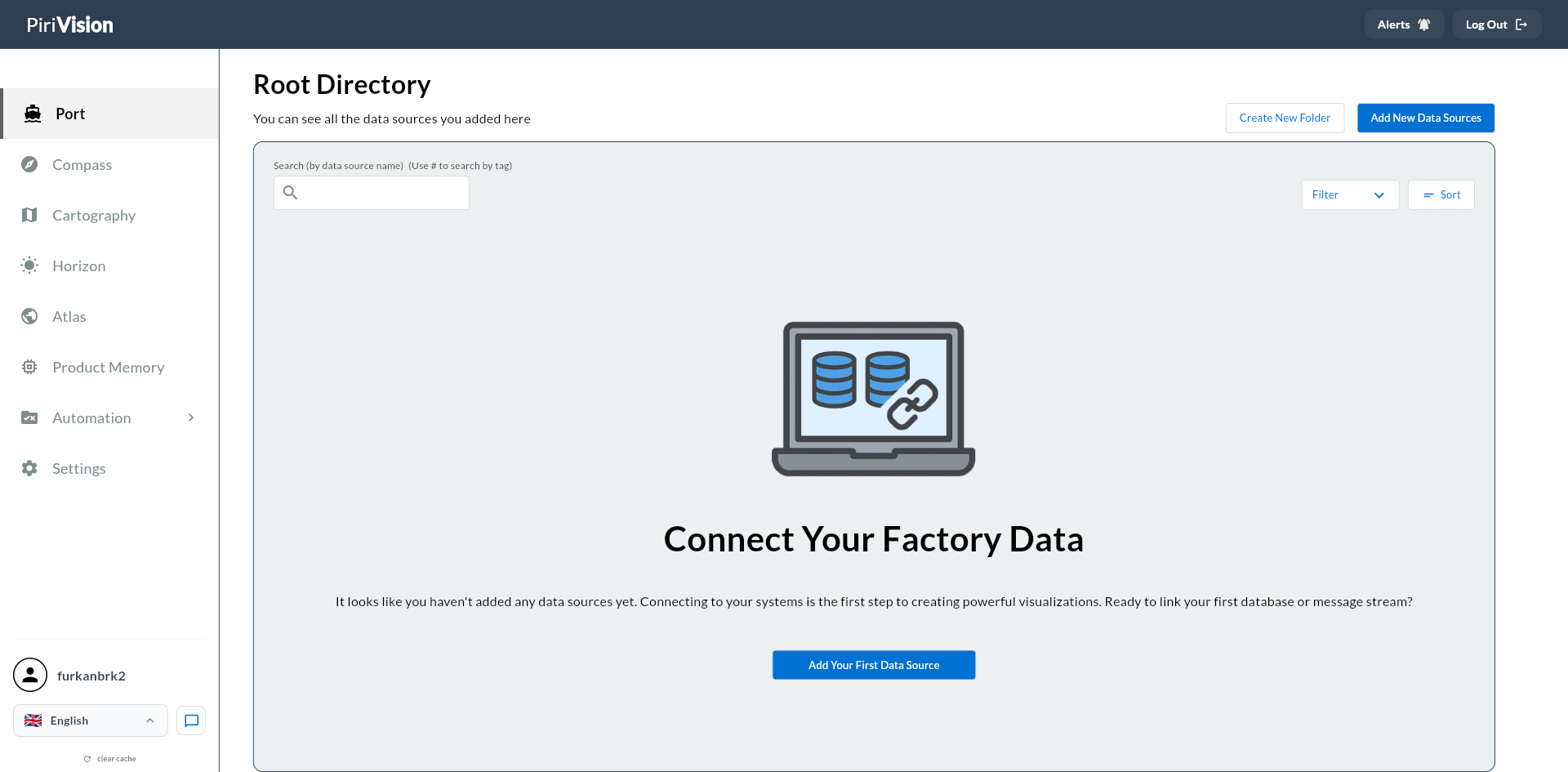
If no data source has been added before, the screen shows a Connect Your Factory Data message.
To add a data source from this screen you can use one of:
- Add New Data Sources
- Add Your First Data Source
2. Start the Add New Data Source Flow
Click the Add New Data Sources button at the top right.
If you are on the empty list screen, the Add Your First Data Source button in the middle starts the same flow.
3. Select the MSSQL Data Source Type
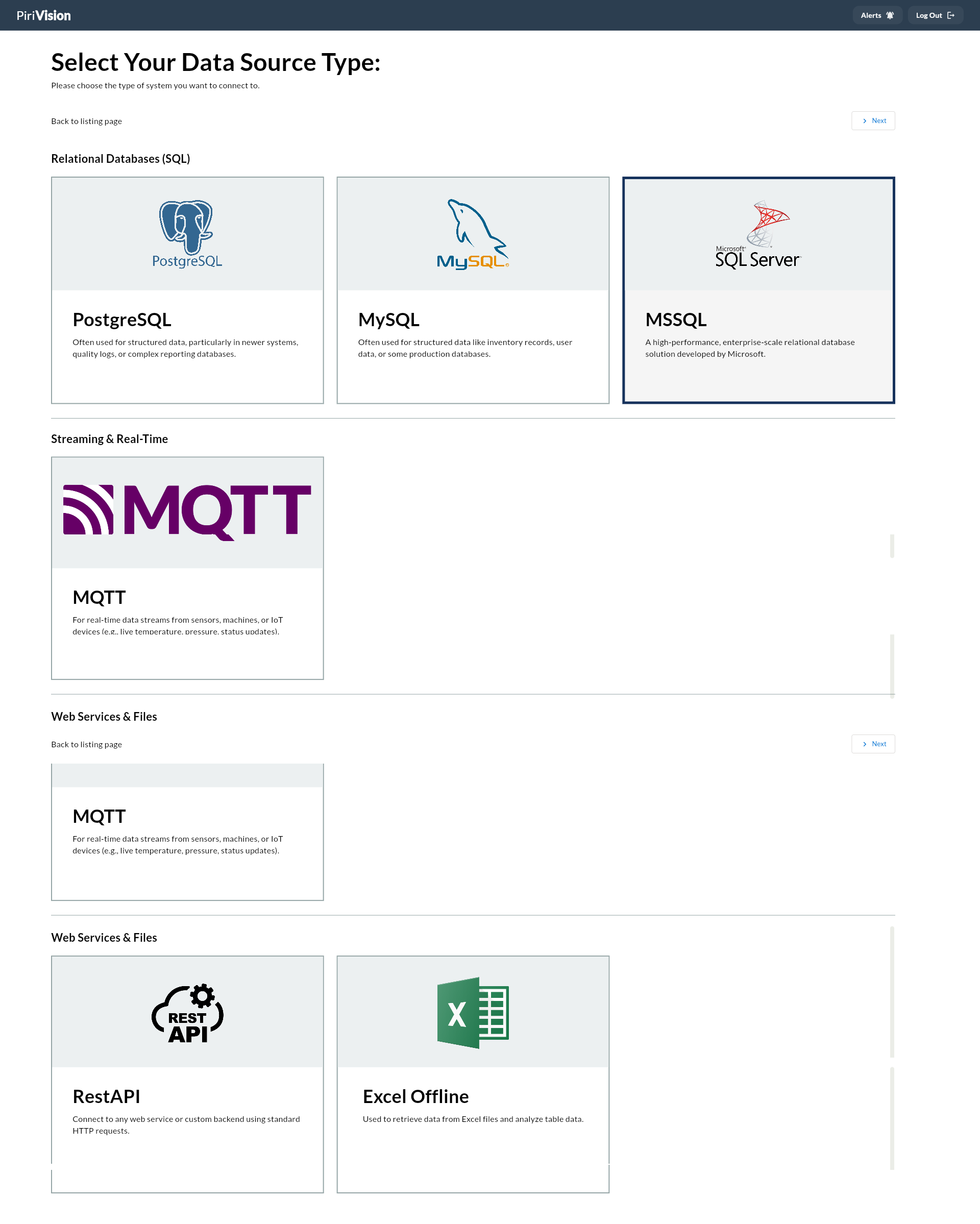
In the screen that opens, data source types are listed under Select Your Data Source Type.
To add MSSQL:
- Go to the Relational Databases (SQL) section.
- Pick the MSSQL card.
- Click Next at the top right.
Info
For relational database connections in Pirivision, PostgreSQL, MySQL, and MSSQL options are available.
4. Fill in the MSSQL Form
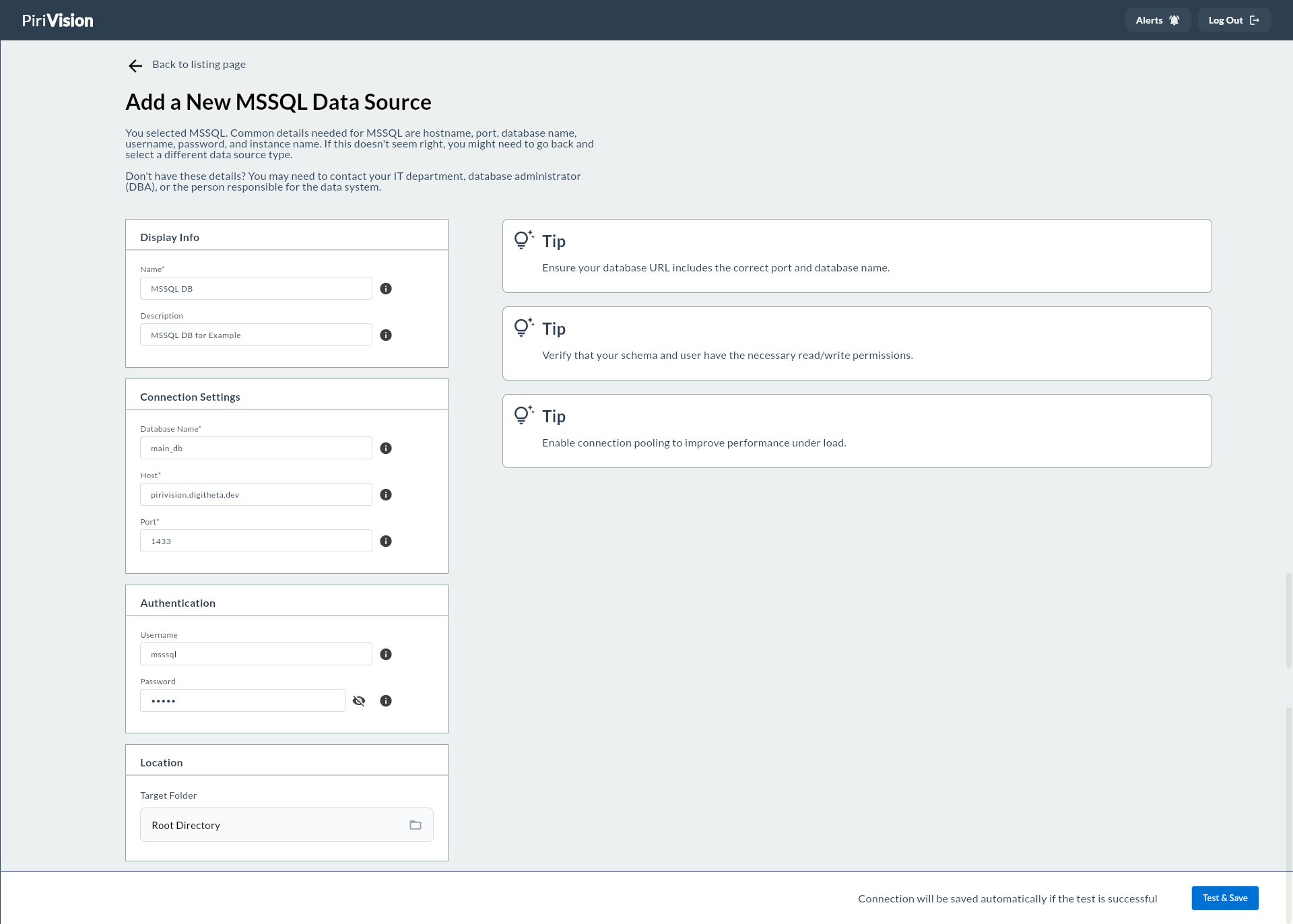
After MSSQL is selected, the Add a New MSSQL Data Source screen opens.
The form consists of four main sections:
- Display Info
- Connection Settings
- Authentication
- Location
Difference from PostgreSQL
The Schema field present in the PostgreSQL form is not present in the MSSQL form. In SQL Server, schema (e.g. dbo) is specified by prefixing it to the table name in the query (dbo.production_logs).
5. Display Info
Display Info determines how the data source appears in the Pirivision UI.
| Field | Required | Description |
|---|---|---|
| Name | Yes | The name used to identify the data source within Pirivision. |
| Description | No | A short note explaining what the data source is for. |
Name
Used to identify this data source on panels and lists.
Good examples:
Bad examples:
Naming Recommendation
Combine plant, system, and data type info in the data source name. For example: Plant2_MES_MSSQL.
Description
An optional field that explains what this connection is for.
Example:
6. Connection Settings
Connection Settings contains the technical info required to connect to the SQL Server.
| Field | Required | Description | Default | Example |
|---|---|---|---|---|
| Database Name | Yes | Name of the database to connect to. | — | mes_production |
| Host | Yes | IP address or domain of the SQL Server. | — | pirivision.digitheta.dev |
| Port | Yes | Port the SQL Server is listening on. | 1433 |
14330, 1500 |
Database Name
The full name of the database to connect to on the server.
Examples:
Note
SQL Server database names are not case-sensitive (default collation), but a typo causes the connection to fail. Copy the name verbatim from Object Explorer → Databases in SSMS.
Host
The network address of the server where SQL Server runs.
Examples:
Warning
The Pirivision server must be able to reach the SQL Server host over the network. Just because you can connect with SSMS from your computer does not mean the Pirivision server can. Check firewall, security group, and port-forwarding settings.
Named Instance
Named instances in SERVERNAME\INSTANCENAME format cannot be entered directly via this form. Fix the TCP port in SQL Server Configuration Manager and enter only the server name/IP as Host, and the fixed port as Port.
Port
The SQL Server connection port.
Default value:
Custom installation examples:
Is TCP/IP Enabled?
In SQL Server installations, the TCP/IP protocol may be disabled by default. In SQL Server Configuration Manager → SQL Server Network Configuration → Protocols for ..., TCP/IP must be Enabled and the service restarted.
7. Authentication
Database user info is entered in the Authentication section.
| Field | Required | Description | Example |
|---|---|---|---|
| Username | Yes | SQL Server username (SQL Authentication) | postgres |
| Password | Yes | The user's password | postgres |
Username
The SQL login name authorized to connect to the database and run queries.
Examples:
Permission Recommendation
For dashboard reads, it is safer to use a separate user/login with read-only access to only the necessary tables (e.g. pirivision_readonly).
Windows Authentication
This version supports only SQL Server Authentication (mixed mode). If the server is configured only as "Windows Authentication mode", switch it to mixed mode in SSMS and restart the service.
Password
The password for this user. The password field is hidden. It can be temporarily revealed via the eye icon if needed.
Security
Do not display the database password in plain text in documents, screenshots, or shareable media. Use a separate login/user for Pirivision.
8. Location
Location determines where the created data source is stored in the Pirivision folder structure.
| Field | Description | Example |
|---|---|---|
| Target Folder | Folder where the data source is saved | PORT |
When you click the Target Folder field, the folder selection dialog opens:
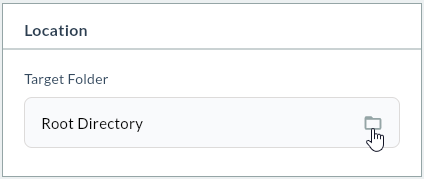
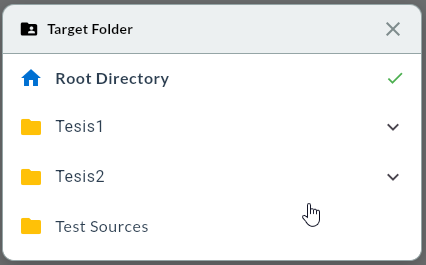
Example folder layout:
PORT/
├── Plant 1/
│   ├── SCADA/
│   ├── MES/
│   └── Quality/
├── Plant 2/
│   ├── SCADA/
│   └── Energy/
└── Test Sources/
9. Save the Connection With Test & Save
After all required fields are filled in, click the Test & Save button at the bottom right.
This works in two stages:
- The SQL Server connection is tested.
- If the test succeeds, the data source is saved automatically.
The screen shows:
Success
If the test is successful, the MSSQL data source is listed on the Port screen and becomes available for query creation in Compass.
Failure
If the test fails, check host, port, database name, username, password, and network access info.
10. Verify the Data Source in the List
After a successful save, returning to the Port main screen shows the created MSSQL data source in the list.
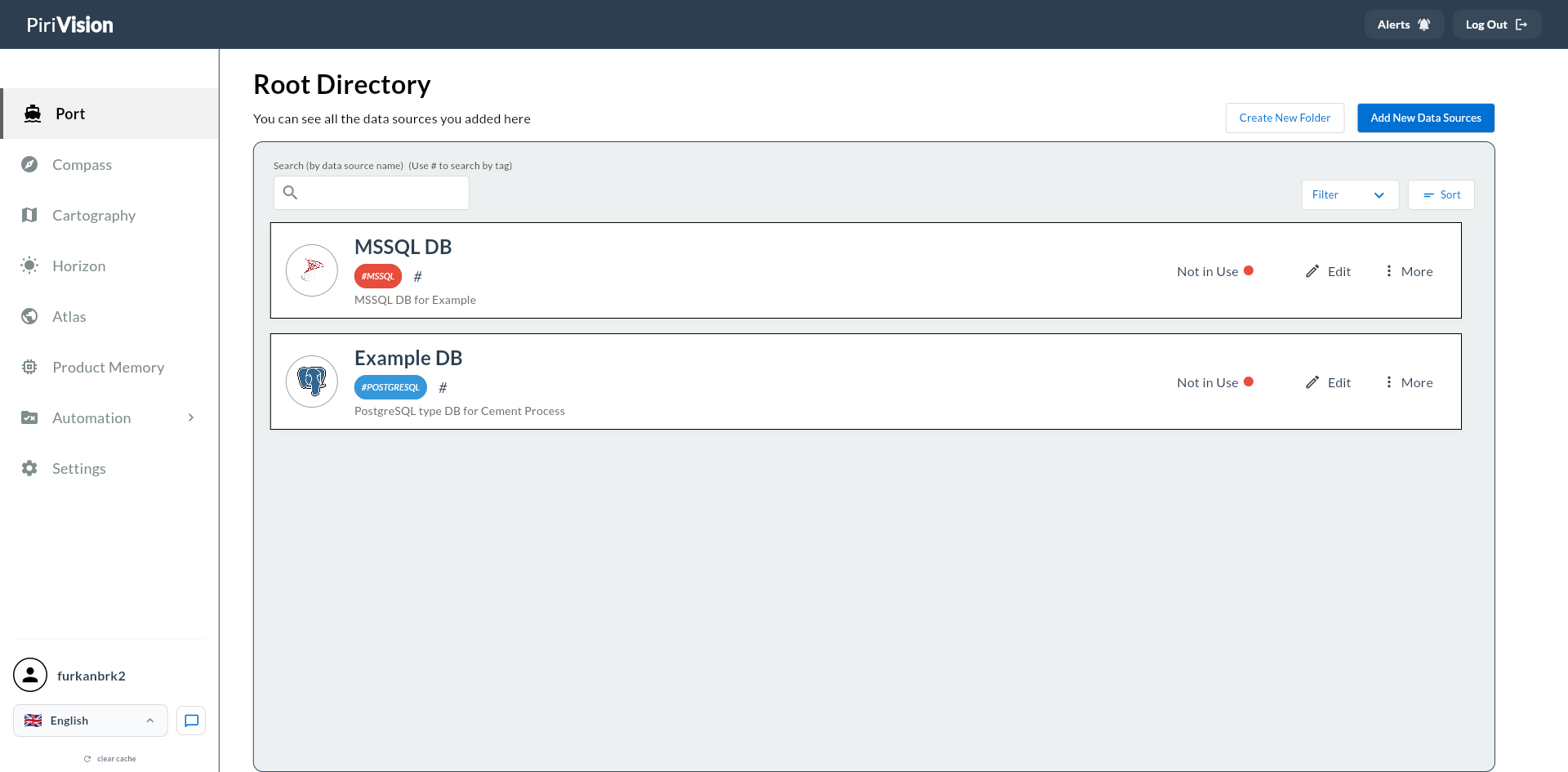
The list card shows the following info and actions:
| Field / Action | Description |
|---|---|
| Data source icon | Indicates this is an MSSQL data source. |
| Name | Data source name. |
| Description | Description text. |
| Usage status | In Use or Not in Use info. |
| Edit | Updates connection info. → Edit Data Source |
| More | Opens the additional actions menu. |
| ↳ Move | Moves the data source to a different folder. → Move Data Source |
| ↳ Duplicate | Creates a new copy with the same settings. → Duplicate Data Source |
| ↳ Delete | Removes the data source. → Delete Data Source |
Delete Operation
The delete operation may not be reversible. If the data source is used by a query, chart, or dashboard, check dependencies before deleting. The backend blocks deletion if it is used in this user's Compass queries (you do not have permission to delete this datasource or a usage check error).
If the data source is not yet used in Compass or a dashboard, the status typically reads:
11. Common Errors
| Error / Symptom | Possible Cause | Solution |
|---|---|---|
| Cannot connect | Host wrong or unreachable | Check IP/domain info and network access. |
| Timeout | Server unreachable or firewall blocked | Check firewall, VPN, security group, and network settings. |
| Authentication failed | Wrong username or password | Verify username/password info. |
| Database does not exist | Wrong database name | Check the actual database name on SQL Server. |
| Permission denied | The user lacks privileges | Grant the user the required read permissions. |
| TLS error | Server requires TLS or certificate validation fails | Check SQL Server TLS/certificate configuration. |
| Will not save | Test failed | The connection is not saved unless the test succeeds. |
12. Next Step
After the MSSQL data source is created in the Port module, the process continues with Compass, Cartography, Horizon, and Atlas.
flowchart LR
    A["Port<br/>MSSQL Data Source"] --> B["Compass<br/>T-SQL Query"]
    B --> C["Cartography<br/>Chart / KPI"]
    C --> D["Horizon<br/>Page / Board Preparation"]
    D --> E["Atlas<br/>Dashboard View"]
Summary
The MSSQL data source addition process:
- Open the Port module.
- Click the Add New Data Sources button.
- Pick MSSQL as the data source type.
- Fill in the Display Info fields.
- Fill in the Connection Settings fields (Database Name, Host, Port — no Schema).
- Enter the Authentication info (SQL Authentication).
- Choose the Target Folder.
- Use Test & Save to test and save the connection.
- Verify the data source in the Port list.
- Create a T-SQL query in the Compass module.
- Create a chart / KPI in the Cartography module.
- Prepare a page or board in Horizon.
- Build the dashboard view in Atlas.